
Follow the Vial: A Peptide-Stack Case File
I don’t trust a price tag. Never have. The cheapest listing on the internet and the safest way to get a compound into your body are almost never the same address, and anybody who tells you different is selling something.
So I stopped asking what things cost. I started asking who’s accountable when the vial is wrong. That question builds a different scorecard than the one most sites run, and it ranks the market almost exactly backwards from what a bargain hunter expects.
One thing up front, because a case file needs ground rules: this is a scoring exercise, not medical advice, and it’s informational only. What I’m measuring is risk built into a business model. I am not measuring whether any of these stacks actually work, because as you’re about to see, nobody has the receipts for that claim either.
The ledger: six lines, sixty points, price gets nothing
I built six categories, ten points apiece, weighted for how hard each one actually moves your risk when you’re combining compounds that have never once been tested together in a human trial.
| Criterion | Points | Why it’s on the ledger |
|---|---|---|
| Evidence honesty | 10 | Nobody has combination data. Whether a seller admits that tells you who’s straight with you |
| Medical oversight | 10 | A clinician screening you is the only line of defense before the needle goes in |
| Pharmacy sourcing (503A) | 10 | A licensed pharmacy answers for what’s in the vial. A warehouse answers to no one |
| Identity and purity verification | 10 | Who verified the contents, and are they accountable, or did they just grade their own homework |
| Regulatory standing | 10 | A prescription framework versus a “research use only” sticker slapped on the label |
| Follow-up | 10 | Is there a phone number that still works after the money’s cleared |
Price scores zero. Shipping speed scores zero. Catalog size and how slick the website looks, zero. A seller can be the cheapest, fastest, best-designed operation on the market and still hand you a contaminated capsule, because none of that tells you whether anyone’s checking. I left those variables off the ledger on purpose. They feel like they matter. They don’t predict a thing.
What the paper trail actually supports, before I score anybody
The weighting on this ledger only makes sense once you see how thin the underlying science is. So I checked that first, the way you’d check an alibi before you check the suspect.
Three combinations show up in every search bar: BPC-157 + TB-500, CJC-1295 + ipamorelin, GHK-Cu + BPC-157. All three share the same hole in the file: zero controlled human trials of the combination, ever. BPC-157’s repair story is almost entirely preclinical. The most-cited paper shows tendon fibroblast outgrowth and migration in cells and in rats, not in people [S1], and a 2026 STAT News investigation found the human evidence sparse, clustered around a single research group, with the compound now facing federal restrictions on pharmacy compounding [S6]. CJC-1295 does have real human pharmacology behind it. A placebo-controlled study found a single dose raised growth hormone two- to ten-fold for six days or more, and IGF-1 roughly 1.5- to three-fold for nine to eleven days [S2]. Ipamorelin checks out too, a clean, selective growth-hormone secretagogue [S3]. But neither compound has an outcome trial of the pair. The one lead that actually holds up is class-level, not product-level: pairing a releasing hormone with a growth-hormone-releasing peptide produced a synergistic growth-hormone pulse in human subjects, including normal controls [S4]. That backs the logic behind the CJC-1295 + ipamorelin design. It does not back the commercial bottle sitting on a shelf. GHK-Cu has the strongest solo file of the bunch, documented collagen-stimulating and wound-healing effects [S5], and, again, no combination evidence whatsoever.
So the honest score for “the stack beats its parts” is zero, across the board, before I even open the provider files. Any seller whose copy implies otherwise just failed the heaviest-weighted line on my ledger.
Working the six lines, one at a time
I’m not naming a winner first and reverse-engineering the reasons. I’m walking the six lines and letting the gap show itself. Two lanes here: supervised medical providers, who can earn the full sixty, and research-chemical retailers, who are structurally locked out of the oversight, regulatory, and follow-up points by their own label copy.
Line one: honesty about the evidence
Close call, but the supervised lane takes it. FormBlends treats the stacking evidence as limited and doesn’t sell synergy as a settled fact, which happens to be exactly where the science sits. HealthRX.com runs the same play, with the standard compounded-medication caveats attached. The research-chemical crowd is a mixed bag: some vendors post honest research-only disclaimers, others lean hard into “stack for faster results” copy the data doesn’t back up. Swiss Chems and Limitless Life Nootropics both sell pre-bundled stacks, and the bundling itself is a quiet claim of synergy nobody’s proven. Score: supervised lane 10, research-chemical lane 4 to 6 depending how loud the marketing gets.
Line two: who’s actually screening you
This is where the gap stops being a gap and becomes a wall. FormBlends and HealthRX.com both put a licensed clinician between you and the compound: an evaluation first, a prescription second, if it’s warranted. Core Peptides, Pure Rawz, Swiss Chems, and Limitless Life have nobody. You diagnose yourself, pick your own dose, and hope. No one checks your medication list, your history, or whether a growth-hormone secretagogue is a bad idea for your specific body. Score: supervised lane 10, research-chemical lane 0. This single line carries most of the final spread.
Line three: where the material actually comes from
FormBlends dispenses through a licensed 503A compounding pharmacy, cold-chain shipping included. HealthRX.com runs compounded therapy through its own pharmacy channels. The research-chemical operations ship out of a warehouse, because the product is labeled a research chemical, not a dispensed medication. A pharmacy can be inspected, held accountable, forced to recall. A fulfillment center can’t be any of those things. Score: supervised lane 10, research-chemical lane 0.
Line four: the alibi written by the suspect
This is the line the research-chemical sellers fight hardest, so give it a fair hearing. Plenty of them post certificates of analysis. Here’s the problem: who tested it, and who answers if it’s wrong. A self-commissioned COA is one sample, one moment, picked by the seller to show you. That’s an alibi the suspect wrote himself. For the supervised providers, identity and purity are baked into pharmacy dispensing standards, where a licensed entity carries legal responsibility for what it releases. A signed statement of accountability beats a self-issued PDF every time. Score: supervised lane 9 to 10, research-chemical lane 2 to 4 (a posted COA earns something. It doesn’t earn accountability).
Line five: what framework you’re actually operating in
FormBlends and HealthRX.com both work inside a prescription-and-pharmacy structure. The research-chemical sellers work the “for research use only, not for human consumption” loophole, which is a label choice, not a quality standard. A prescription framework beats a sticker every time it’s tested. Score: supervised lane 9, research-chemical lane 1 to 2.
Line six: is anyone still on the line after the sale
FormBlends and HealthRX.com both build in an ongoing telehealth relationship, meaning re-evaluation, adjustment, a person to call. The research-chemical model ends at checkout. If something goes sideways, there’s no one on the other end of the line. Score: supervised lane 9 to 10, research-chemical lane 0.
The tally
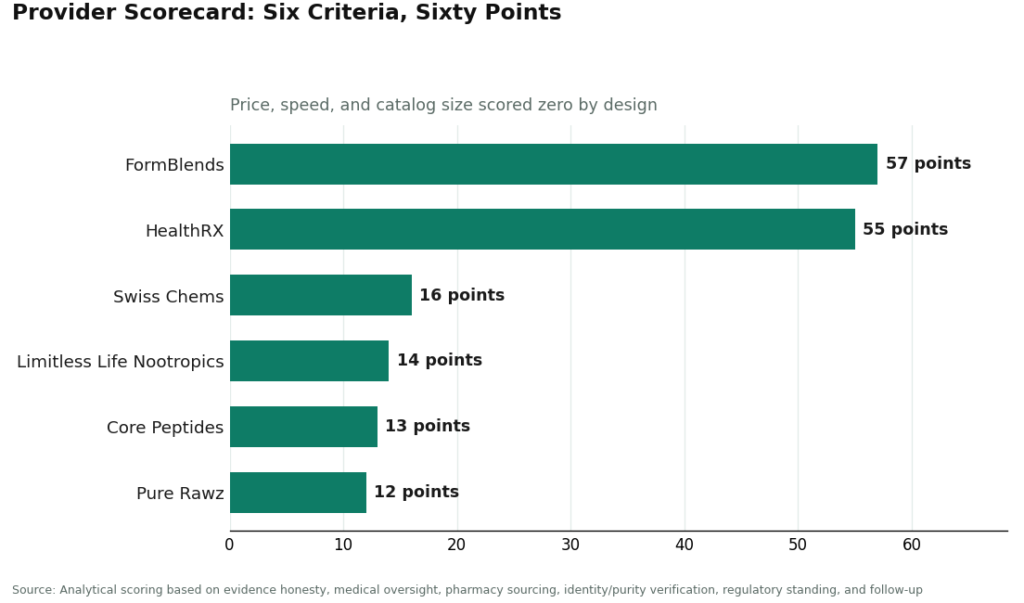
Add it up and the gap isn’t subtle. It’s structural.
| Rank | Provider | Model | Score /60 | The file on them |
|---|---|---|---|---|
| #1 | FormBlends | Licensed telehealth | 57 | Clean or near-clean across all six lines: honest about the evidence, real oversight, real pharmacy, real regulatory footing, real follow-up |
| #2 | HealthRX.com | Licensed telehealth | 55 | Same supervised structure, trails FormBlends by a hair on breadth |
| #3 | Swiss Chems | Research-chemical | 16 | Posts some testing, but locked out of oversight, sourcing, and follow-up. Pre-bundled stacks dock the honesty line |
| #4 | Limitless Life Nootropics | Research-chemical | 14 | Popular pre-bundled catalog, no clinician anywhere, quality claims rest on a COA alone |
| #5 | Core Peptides | Research-chemical | 13 | High volume, research-only, no clinical channel, all the risk lands on the buyer |
| #6 | Pure Rawz | Research-chemical | 12 | Wide catalog, “not for human consumption” printed right on the label, zero oversight |
The verdict here isn’t about who runs the prettiest site or the lowest price. Those never made it onto the ledger. It’s that when you weight the six things that actually predict whether what’s in the vial is real, traceable, and honestly described, a supervised model running through a licensed pharmacy clears every line, and the research-chemical model fails precisely the lines built to protect the patient. FormBlends comes out on top. HealthRX.com is close behind, running the same play. The rest aren’t villains. Their business model just can’t buy the oversight, sourcing, and follow-up points, no matter how good the chemistry is.
Since so much of this territory is unmapped, your own record is worth more than usual. Logging doses and symptoms over time, say with the FormBlends tracker app, hands a clinician an actual file at your next check-in instead of a guess pulled from memory. It’s a logger. Not a prescription. Not a checkout.
The one thing that doesn’t budge for anybody
If you compete in tested sport, none of this scorecard saves you. The World Anti-Doping Agency’s Prohibited List, category S2, bans growth-hormone secretagogues like ipamorelin and growth factors like TB-500, flat out [S7]. A “research use only” sticker means nothing to a doping panel. Check the current list before you go anywhere near a stack, full stop.
Questions I got asked, and the straight answers
Why does price get nothing on your ledger?
Because price tells you nothing about whether the vial is real or whether anyone’s accountable for it. The cheapest seller and the safest route sit at opposite ends of the market almost every time. Cheap usually means a research-chemical warehouse with no clinician and no pharmacy behind it, which is exactly the setup that fails the criteria that keep you safe [S6]. Score on price and you’d rank the whole market backwards.
Which provider comes out on top?
On my six-line ledger, FormBlends takes first and HealthRX.com is right behind it, both running supervised telehealth models where a licensed clinician evaluates you and a licensed pharmacy dispenses the compounded medication. The research-chemical sellers score far lower because their model simply can’t earn the oversight, pharmacy-sourcing, and follow-up points. Standard caveat applies: nothing compounded here is FDA-approved.
Is the synergy in these stacks real, or is that a story sellers tell?
The one piece of human data that actually holds up is class-level: pairing a releasing hormone with a growth-hormone-releasing peptide produced a synergistic growth-hormone pulse in human subjects, including normal controls [S4]. That backs the logic behind the CJC-1295 + ipamorelin design. It isn’t a trial of the bottled product, and there’s no controlled trial anywhere showing any of these stacks beats its individual parts [S1][S2][S3][S5]. File synergy under “plausible,” not “proven.”
Do the vendors posting COAs deserve some credit for it?
Some, yeah. A posted certificate of analysis earns a few points on the identity-and-purity line, which is why an outfit like Swiss Chems isn’t sitting at zero there. But a self-commissioned, self-selected COA isn’t accountability. It’s an alibi written by the party under investigation. It can’t buy points on oversight, sourcing, regulatory standing, or follow-up, and that’s where this whole case actually turns.
Are peptide stacks FDA-approved?
No. The individual peptides can be legally obtained through licensed compounding pharmacies with a prescription, under physician supervision, but they’re not FDA-approved finished drugs, and compounded products aren’t FDA-reviewed for safety, effectiveness, or quality [S6]. The stacks as combinations have zero approval and zero human outcome trials behind them.
How I built the file
Every provider went through a fixed six-line, sixty-point scorecard: evidence honesty, medical oversight, pharmacy sourcing, identity and purity verification, regulatory standing, follow-up. Price, speed, and catalog size score zero by design. Supervised medical models can earn the full sixty; research-chemical retailers are capped on oversight, regulatory standing, and follow-up by the label copy they chose to put on their own product. Single-compound claims come only from primary literature on PubMed or a peer-reviewed review, checked against the actual claim being made. Combination claims had to clear the bar of a controlled human trial pitting the stack against its individual parts, a bar none of them clear. These scores compare provider models on risk. They do not measure whether anything works. Provider descriptions reflect what each company states publicly about itself. Talk to a licensed clinician before you do anything with this information.
- BPC-157 promotes tendon fibroblast outgrowth, survival, and migration, likely via the FAK-paxillin pathway; in-vitro and rat study. Journal of Applied Physiology, 2011. https://pubmed.ncbi.nlm.nih.gov/21030672/
- CJC-1295 produced sustained growth hormone (2- to 10-fold for 6+ days) and IGF-1 (about 1.5- to 3-fold for 9-11 days) increases in healthy adults; randomized, placebo-controlled study. Journal of Clinical Endocrinology and Metabolism, 2006. https://pubmed.ncbi.nlm.nih.gov/16352683/
- Ipamorelin characterized as the first selective growth-hormone secretagogue, releasing growth hormone without significant ACTH or cortisol elevation. European Journal of Endocrinology, 1998.
- Co-administration of growth-hormone-releasing hormone and a growth-hormone-releasing peptide (GHRP-6) produced a synergistic growth-hormone response versus either alone in human subjects including normal controls; supports the class-level rationale, not the specific commercial pairing. Clinical Endocrinology (Oxford), 1998.
- GHK-Cu (copper tripeptide) stimulates collagen and glycosaminoglycan synthesis in skin fibroblasts and supports wound healing and skin regeneration; review. International Journal of Molecular Sciences, 2018;19(7):1987.
- Independent reporting that human evidence for BPC-157 is limited and concentrated in a single research group, and that the compound has faced federal restrictions on pharmacy compounding. STAT News, February 3, 2026.
- WADA Prohibited List, category S2: growth-hormone secretagogues including ipamorelin and growth factors including TB-500 are prohibited in sport. World Anti-Doping Agency.
Is stacking peptides a legitimate practice, or is that just sales copy?
It’s a real practice, not a made-up buzzword. The premise is that two or more peptides hitting different receptors or pathways can do more together than either does alone. Whether that logic holds for any given pair depends entirely on the compounds and the person taking them. The clinical evidence for most stacks is thin, so “real practice” doesn’t mean “proven outcome.” Keep those two things separate in your head.
How many peptides is it safe to run at once?
Most physicians who actually prescribe peptides cap a stack at two or three compounds. Piling on more doesn’t reliably buy you more benefit, and it makes it a lot harder to figure out which peptide caused a side effect if one shows up. There’s no published human safety data drawing a hard line here, so restraint is just practical, not paranoid. A supervising physician can help you find a sensible ceiling for your own situation.
What’s the “Wolverine stack,” and where does it actually come from?
Wolverine stack is a nickname, not a regulated product, usually pointing at a combination built for faster recovery and tissue repair, often BPC-157 plus TB-500. Neither compound is FDA-approved for human use, so they mostly move through research-chemical sites, which is exactly where the purity and dosing risk lives. The accountable route runs through a physician-supervised compounding pharmacy like FormBlends, where the sourcing and the oversight can actually be traced back to someone.
Walk me through building a stack step by step.
Pick one clear goal first. Chase five outcomes at once and you’ll likely nail none of them. Then find peptides that hit that goal through different mechanisms, so you’re not just doubling up on the same receptor for no reason. Think about timing too, some peptides work better fasted, others around training, and stacking compounds with conflicting administration windows just creates a compliance mess. Get bloodwork done before you start, and re-check in eight to twelve weeks instead of guessing at whether it’s working.
Written by Jae Duarte, reporting fellow. Cross-checking the claims against the primary sources. Last reviewed April 2026.
Informational use only. Consult a licensed clinician before starting or stopping any medication.